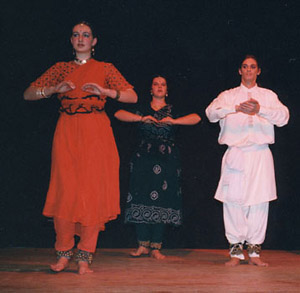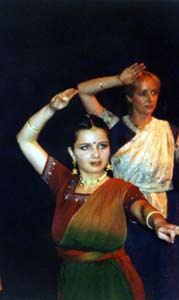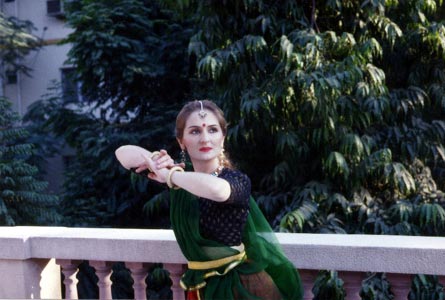
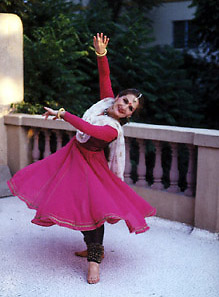
![]() Dora as a student at "Kadamb" centre of dance and music. |
While
following the principles of the dance training one learns to understand
the enormous resources of the body; its energy, power and self esteem. The dynamic principles of line, centre, balance and flow are as significant for the dance as they are for life. These principles are breaking down if dance forms are limited to verbal, interpretative and spiritualized contents only. The body in our times is endangered of beeing reduced to its functions as a commodity only – to work, to satisfy and be satisfied. Beeing therefore more and more desensualized, fragmentized and alienated, it has turned to a mere cosmetic appendage, deprived of its inherent qualities of integration, action, dignity and struggle. |
|
|
In
all the classical dance forms of the subcontinent, Indias ancient culture
is expressed: the principle to see the body as the centre of the world and to connect it with the society, the community, the environment and the cosmos. The dancer with her extraordinarily manifold means of expression describes the stories as well as impersonates the varied characters of the mythology of India. However, above and superior of all expressions, RHYTHM is acknowledged as an universal and abstract principle of the highest and supreme order. Hence, the elements of mime, gesture, movement, speech, emotions and intellect are its basic accessories and under its service. |
![]() |
|||
|
In
KATHAK, of the three main components that all classical
dance forms share, (nritta, nritya, natya), NRITTA
is highly emphasized. This aspect is concerned solely
with rhythmic movement and therefore called "pure dance"; music
and rhythm are visualized and reproduced by means of abstract gestures
of the body, limbs and hands, recitation of mnemonic syllables (bols)
and extensive and precise use of footwork (tatkar). |
![]() |
Learning
of how to go along with and adhere to the laws of
RHYTHM with precision and clarity gives the western student
time to prepare her or his body and mind for the culturally challenging
and very subtle technical aspects of expressional dance (moods, sentiments)
in nritya and natya. Experiencing the pure aesthetic delight of RHYTHM, the student finds selffulfilling enjoyment from the first day of learning. Hundreds of tinkling brass bells around the ankles (ghungurus) as well as the bols, the dance syllables that are reproduced by them, add dimensions to the dance training that are unknown to our culture and immensely attractive. |
![]() |
Dora,
with her scientific background as a paedagoge and her profound teaching experience over two decades, has proved a gifted teacher. Besides giving regular classes for beginners and advanced students, she conducts workshops in Germany, Austria, Swisserland, Italy and North-East India and gives lecture demonstrations at schools and kindergardens. She not only invites Indian KATHAK dancers to Germany but also encourages and guides advanced students to visit India which she finds neccessary in order to experience this art form at the roots and understand its splendour, beauty, depth and virtuosity. |
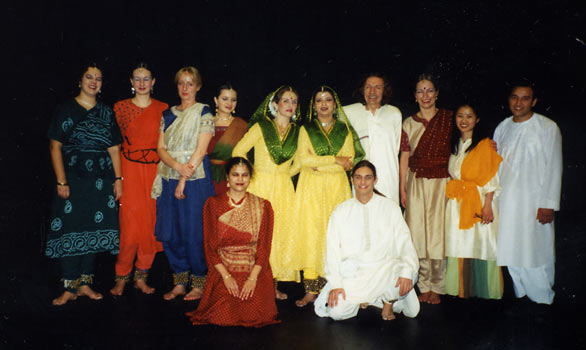
![]() Kathak-students with guest star Kavita Thakur (right hand to Dora) |